
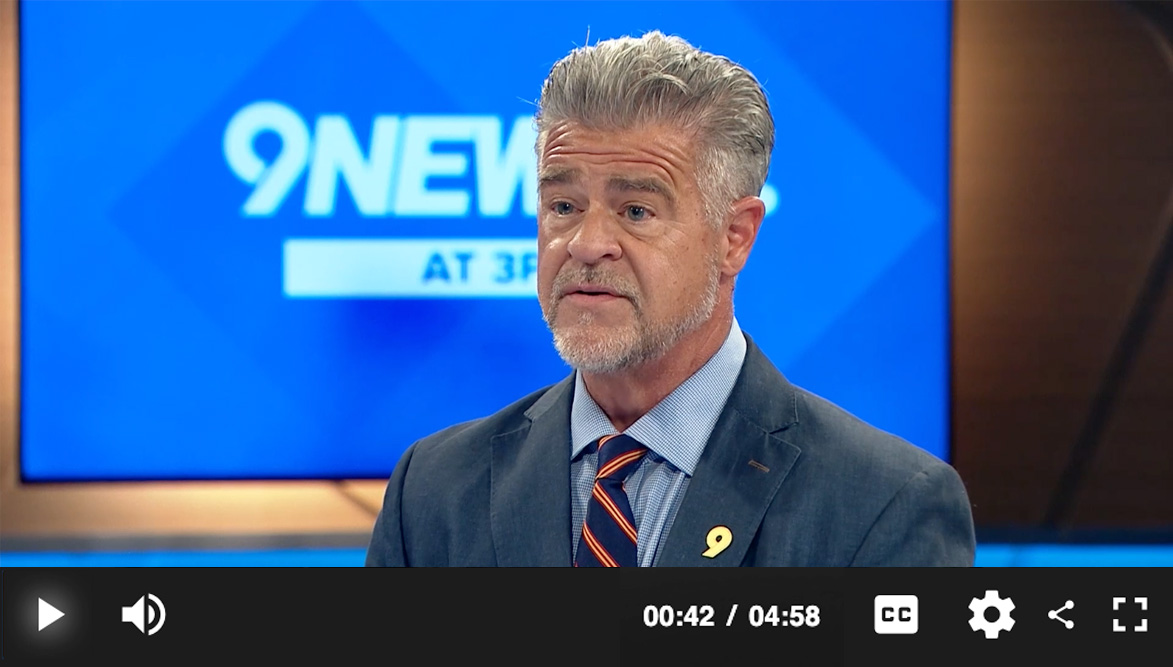
Christopher R. Decker, managing partner at The Law Offices of Decker & Jones, appeared live on 9NEWS four times during the week of September 1, 2026 to provide legal analysis as jurors in the Lindsay Clancy murder trial deadlocked and the case ended in a mistrial. He joined the station on Tuesday, September 1 at 7:10 a.m. and again at 10 a.m., on Thursday, September 3 at 7:10 a.m., and on Friday, September 4 at 3:10 p.m.
The case
Lindsay Clancy, a former labor and delivery nurse, was charged with murder in the January 24, 2023 strangling deaths of her three young children — Cora, Dawson and Callan. Her attorney, Kevin Reddington, did not dispute that she killed them. The trial in Plymouth Superior Court turned instead on whether she was criminally responsible at the time, with the defense arguing she was in the grip of postpartum psychosis and prosecutors arguing she was in control of her actions.
Seven days of deliberations
Jurors began deliberating after closing arguments on August 27. On Tuesday, September 1, they reported that they could not reach a unanimous decision, and Judge William Sullivan sent them back to keep working.
On Thursday, September 3, the jury’s foreperson delivered a note telling the judge that a single juror would not follow the court’s instructions on reasonable doubt. Reddington asked Sullivan to dismiss that juror. Prosecutors objected, and the judge declined, saying it was not his place to side with one juror or with the other eleven.
Asked on 9NEWS how common it is for one juror to hold up a verdict, Decker said it is less unusual than it looks.
“Any time a jury is split, it depends on how many folks are on one side or the other. It’s not totally uncommon that you would have a split with just one juror holding out. It doesn’t mean it’s improper. It just means the way the jury worked through this case, there was one juror that would not go along with the others.”— Christopher R. Decker, 9NEWS, September 4, 2026
A last-minute appeal, then a mistrial
On Friday morning, September 4, the jury sent a third note. “It is with a heavy heart that we report we are unable to come to a unanimous decision and will not be able to,” Sullivan read aloud in court.
What followed was, in Decker’s words, “very, very unique.” Sullivan told the attorneys he intended to declare a mistrial but would hold that decision for about an hour. The defense used the hour to file an emergency motion with the Massachusetts Supreme Judicial Court, asking it to step into the case and direct the trial judge. The court declined to get involved, and when the parties returned, Sullivan did exactly what he had said he would do: he declared the jury deadlocked and the trial a mistrial after seven days of deliberations.
What a hung jury actually means
A mistrial on a deadlocked jury is not an acquittal. Because the first trial ended without a verdict, double jeopardy does not bar a second one, and the charges remain live. Whether to try the case again, Decker explained, “is the sole discretion of the district attorney’s office.” In practice the two sides reset a trial date and the prosecution decides whether it actually wants to proceed — and that decision, he said, will turn largely on what the jurors themselves say.
“If, for example, it was 11–1 to convict … then the prosecution is almost certain to seek a retrial. If on the other hand it was 11–1 to acquit, then that district attorney’s office needs to take a hard look at whether they really think that they can prove, in a different trial to a different jury, proof beyond a reasonable doubt.”— Christopher R. Decker, 9NEWS, September 4, 2026
Decker also predicted the jurors would not stay silent. “There are 12 people who everybody in this nation wants to hear from,” he said, “and those are the jurors who sat through this case.” Their account, he noted, would inform both sides: a prosecutor might call a different expert, the defense might change its approach, and each would want to understand what set the one holdout apart. Several jurors did speak publicly within days, and the foreperson said the holdout had admitted he had reasonable doubt.
Plymouth County District Attorney Timothy Cruz said outside the courthouse that his office would not announce a decision that day. Judge Sullivan scheduled a status hearing for September 29 and indicated he wanted any second trial to happen in the fall.
Colorado works the same way on this point. A criminal verdict here must be unanimous, a jury that cannot get there produces a mistrial rather than an acquittal, and the district attorney then decides whether to try the case again. For a defendant, that means the period after a hung jury is not the end of the fight — it is often the most important window in the case, and the one where the record built at the first trial matters most.
If you are facing serious criminal charges in Colorado, or have questions about what a mistrial or hung jury means for your case, call our office at 303-573-5253.
Watch the segment: Judge declares mistrial in trial of Lindsay Clancy: Legal analysis — 9NEWS. Juror accounts: CNN.